Body Language and Executive Presence: The Non-Verbal Signals That Build Leadership Authority
July 10, 2026
"The most important thing in communication is hearing what is not said."
-- Peter Drucker
Researchers at UCLA found that in face-to-face communication, 55 percent of the impression we make comes from body language, 38 percent from vocal quality, and only 7 percent from the actual words we say.
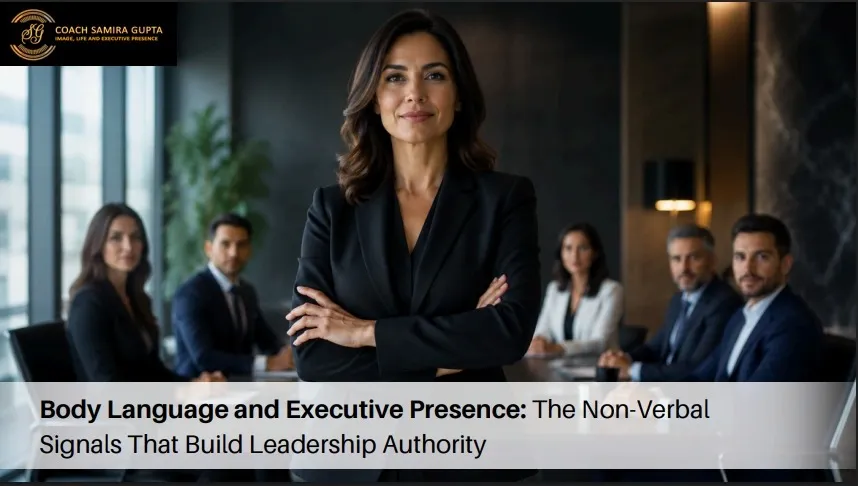
For senior leaders, this is not an academic curiosity. It is a strategic reality. The majority of the authority you project in any given professional interaction has nothing to do with what you say. It has everything to do with how you occupy the room before, during, and after you say it.
In my work as an Executive Presence Coach, body language is one of the most direct and highest-leverage areas of development for senior leaders. The changes are visible to others immediately, the feedback is rapid, and the improvements compound across every interaction, board presentations, team meetings, client engagements, and public appearances.
Postural Authority
Posture is the single most powerful non-verbal signal of leadership authority. Research by social psychologist Amy Cuddy at Harvard Business School shows that expansive, open postures activate hormonal changes that produce measurable increases in confidence, risk tolerance, and decisive thinking.
For senior leaders, this means sitting fully upright rather than perching at the edge of a chair, occupying the width of your seat rather than compressing yourself, and moving through rooms with a deliberateness that signals before a word is spoken that this is a person who belongs here.
Eye Contact: Quality Over Duration
Sustained, deliberate eye contact is one of the most powerful non-verbal signals of confidence and genuine authority. The key distinction is quality over duration. Brief, darting eye contact signals anxiety. Sustained eye contact that regularly sweeps the room signals engagement and ownership.
In India's corporate context, eye contact norms carry cultural nuance, including specific hierarchy dynamics and gender considerations. Developing the cultural intelligence to deploy eye contact precisely across diverse stakeholder contexts is part of building Executive Presence in the Indian environment specifically.
The Power of Physical Stillness
The leader who fidgets, shifts constantly, or fills pauses with unnecessary movement is broadcasting internal anxiety regardless of what they are saying. Physical stillness, particularly in moments of challenge or pressure, is one of the most reliable non-verbal signals of composure and control. The ability to sit in absolute stillness while an adversarial question is being asked, and then respond with measured deliberateness, is a distinguishing quality of the most authoritative senior leaders I have worked with.
Vocal Non-Verbals: Pace, Pause, and Tone
The non-verbal dimensions of voice carry more authority signal than the words themselves. The leader who speaks too quickly signals anxiety. The one who speaks at a measured, deliberate pace with strategic pauses signals control and gravitas. The one whose pitch rises at the end of statements, making them sound like questions, signals uncertainty even when the content is correct.
In my One-to-One Coaching sessions, video review of a leader's body language and vocal presence in actual professional settings consistently reveals patterns that the leader was completely unaware of and that were significantly affecting how they were being perceived. Seeing yourself as others see you is one of the fastest ways to close this gap.
Body Language in Virtual and Hybrid Settings
A significant proportion of senior leadership interactions now happen on video. The non-verbal signals that build authority in a physical room translate to the virtual environment but require specific adaptation: camera angle, lighting, framing, and the quality of stillness on screen. Leaders who have not specifically developed their virtual presence are operating at a real disadvantage in an environment where many of their most consequential interactions now happen on a screen.
Frequently Asked Questions
Q: Can body language habits be changed?
A: Yes, with focused practice. Body language is a set of learned physical habits, and the most effective approach combines awareness of the specific patterns undermining authority, targeted practice of replacement behaviors, and conscious application until the new patterns become automatic. Most leaders see visible improvement within 4 to 6 weeks.
Q: What are the most common body language mistakes in board presentations?
A: Starting before fully establishing presence in the room, looking at the screen rather than the audience, holding materials in ways that signal anxiety, and failing to use strategic pause, each of which quietly undercuts authority regardless of the quality of the content.
Q: How does body language coaching work in One-to-One sessions?
A: Typically through video review of the leader in real or simulated professional settings, identification of the specific patterns affecting authority, and targeted practice integrated back into real high-stakes situations with follow-up review.
Q: Is this relevant for leaders who primarily work virtually?
A: Especially so. The virtual environment is less forgiving of weak non-verbal signals, since posture, eye contact quality, and vocal presence are the primary channels of authority available on a screen.
Develop the non-verbal authority your leadership demands. Coach Samira Gupta works with India's senior leaders through personalised One-to-One Coaching.
Call: +91 9958934766 | Email: samira@auraaimage.com | Website: www.samiragupta.com