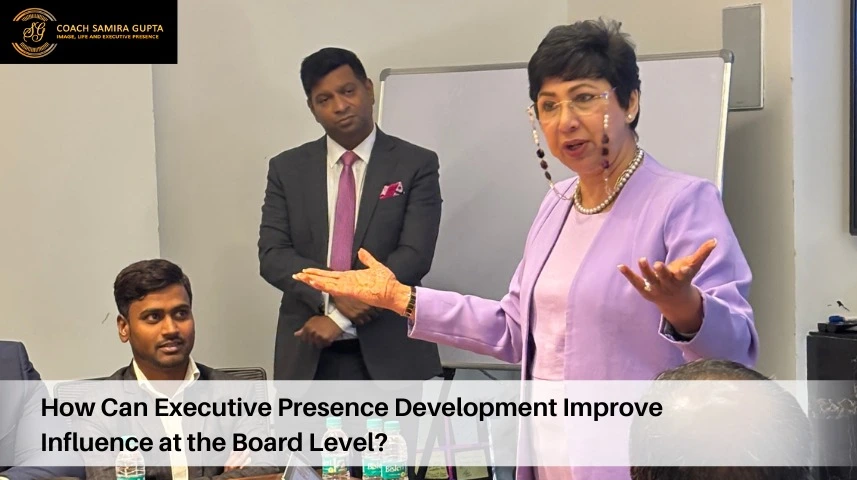
How Can Executive Presence Development Improve Influence at the Board Level?
January 30, 2026
“Leadership is not about being the loudest voice, but the most trusted one.” — Peter Drucker
Boardrooms are not influenced by authority alone. They respond to clarity, credibility, and composure.
Many senior leaders enter board discussions with deep expertise, yet struggle to create consistent impact. Their insights are valid, but conversations move on. Recommendations stall. Presence feels diluted, not because of capability, but because of how leadership is experienced in the room.
This is where Executive Presence Development becomes a strategic differentiator.
For leaders operating in Gurugram, Delhi, and across Delhi NCR, Executive Presence determines whether ideas shape decisions or disappear into minutes.
This article explains how Executive Presence Development strengthens board-level influence, why it matters at senior levels, and how leaders can develop presence that commands trust when stakes are highest.
Executive Presence Development: Quick Answer
Executive Presence Development improves board-level influence by strengthening how leaders communicate strategy, project confidence, manage scrutiny, and build trust in high-stakes boardroom environments.
For senior professionals in Delhi NCR, it bridges the gap between technical expertise and executive authority ensuring ideas are heard, trusted, and acted upon.
What Is Executive Presence Development?
Executive Presence Development is a structured leadership process that strengthens how leaders project confidence, authority, and strategic thinking through communication, behavior, and decision ownership.
It goes far beyond presentation polish or speaking fluency. True Executive Presence integrates:
- Strategic leadership communication
- Emotional intelligence for leaders
- Executive body language and non-verbal cues
- Decision framing at enterprise level
- Stakeholder influence and perception management
At the board level, presence is interpreted as leadership readiness. When developed intentionally, it signals competence, trustworthiness, and executive maturity.
Why Board-Level Influence Requires a Different Leadership Skill Set
The Boardroom Is a High-Stakes Environment
Board interactions are defined by:
- Limited time for explanation
- Complex financial and strategic decisions
- Diverse stakeholder priorities
- Power dynamics among senior leaders
In this environment, influence is earned through clarity, composure, and strategic relevance, not volume or detail.
Common Executive Presence Gaps Observed in Senior Leaders
Even high-performing leaders often struggle with:
- Over-explaining instead of synthesizing
- Defensive responses during board questioning
- Inconsistent executive body language
- Weak strategic framing of recommendations
These gaps quietly erode boardroom credibility, regardless of expertise.
How Executive Presence Development Improves Board-Level Impact
1. Strengthens Strategic Communication
Executive Presence Development trains leaders to:
- Structure board-level narratives
- Translate data into insight
- Present risks, outcomes, and recommendations clearly
Key Insight:
Boards engage when leaders communicate why it matters, not just what happened.
2. Builds Authority Without Aggression
Board-level presence is not dominance, it is composed confidence.
Through Executive Presence coaching, leaders develop:
- Calm assertiveness
- Controlled vocal tone
- Purposeful executive body language
This balance earns respect and keeps discussions productive under pressure.
3. Enhances Decision Credibility
Boards assess not only decisions, but how leaders stand behind them.
Leadership development coaching helps executives:
- Defend positions with logic, not emotion
- Respond to scrutiny with composure
- Demonstrate accountability and foresight
Presence transforms decisions into trusted leadership signals.
4. Improves Stakeholder Influence Beyond the Boardroom
Board-level influence extends well beyond meetings.
Leaders develop skills in:
- Persuasive leadership communication
- Relationship-based influence
- Managing executive perception across stakeholders
This ensures alignment before, during, and after board interactions.
Industry Evidence Supporting Executive Presence Development
Research published by Harvard Business Review consistently highlights that Executive Presence accounts for a significant portion of leadership effectiveness often outweighing technical expertise in senior promotions.
According to the Center for Creative Leadership, leaders with strong executive communication skills are significantly more likely to be perceived as ready for enterprise-level roles.
These findings reinforce why Executive Presence Development is no longer a “soft skill,” but a core leadership investment.
Real-World Leadership Transformation
A CFO based in Gurugram struggled to gain board engagement. Her financial analysis was strong, yet her recommendations were often bypassed.
Through focused Executive Presence Development coaching with Coach Samira Gupta, she worked on:
- Strategic message framing
- Board-level questioning techniques
- Executive Presence in leadership communication
Within six months:
- Her proposals gained faster approval
- She became a primary advisor during critical decisions
The transformation was not about knowledge. It was about influence.
Benefits of Executive Presence Development
Leaders who invest in Executive Presence experience:
- Stronger boardroom confidence
- Clearer leadership communication
- Higher perceived executive credibility
- Improved decision influence
- Enhanced professional executive image
- Greater strategic visibility
Who Needs Executive Presence Development in Delhi NCR?
- CXOs and senior managers
- Board-facing leaders
- High-potential executives preparing for enterprise roles
- Leaders transitioning into strategic positions
- Professionals in Gurugram, Delhi, and Delhi NCR seeking advancement
Common Mistakes That Reduce Executive Presence
- Treating presence as presentation skills alone
- Ignoring emotional intelligence for leaders
- Overloading boards with operational detail
- Neglecting non-verbal executive communication
- Avoiding strategic storytelling
These habits quietly dilute leadership impact.
Executive Presence Development in Delhi NCR with Coach Samira Gupta
Coach Samira Gupta is a leadership development expert specializing in Executive Presence Development for senior professionals and board-facing leaders in Delhi NCR.
Her approach combines:
- Personalized leadership assessments
- One-on-one executive coaching
- Strategic communication frameworks
- Real boardroom simulation scenarios
- Feedback-driven improvement cycles
Each engagement is aligned to the leader’s role, industry, and board responsibilities.
Before vs After Executive Presence Development
| Before Development | After Development |
| Hesitant communication | Confident, concise leadership voice |
| Reactive responses | Strategic, composed engagement |
| Limited influence | Trusted board-level authority |
| Inconsistent presence | Strong executive gravitas |
FAQs: Executive Presence Development
1. What is Executive Presence Development in leadership roles?
Executive Presence Development enhances how leaders communicate, influence, and project authority in high-stakes environments by integrating strategic communication, emotional intelligence, and executive behavior.
2. Why is Executive Presence Development important for board-level leaders?
Because board decisions depend on clarity, confidence, and trust. Executive Presence helps leaders handle scrutiny, articulate strategy, and build credibility beyond technical expertise.
3. How does leadership communication training support Executive Presence?
Leadership communication training strengthens message structure, executive voice, and persuasive framing, enabling leaders to communicate insights rather than operational detail.
4. Can Executive Presence Development help introverted leaders?
Yes. It focuses on clarity, composure, and strategic influence, not personality change making it highly effective for introverted leaders.
5. How long does Executive Presence Development coaching take?
Most leaders experience measurable improvements within three to six months, depending on goals and board exposure.
6. Is Executive Presence Development different from leadership coaching?
Yes. It specifically targets visibility, influence, and perception at senior and board levels, rather than general leadership skills.
Conclusion
Executive Presence Development is not about changing who you are. It is about elevating how your leadership is experienced.
For board-level professionals in Delhi NCR, it becomes the bridge between competence and influence, insight and impact, authority and trust.
When leadership presence is intentional, influence follows.
Call: +91 9958934766
Email: samira@auraaimage.com
Website: www.samiragupta.com
Executive Presence Development with Coach Samira Gupta helps senior leaders in Delhi NCR influence board decisions with confidence, clarity, and credibility.
Book your Executive Presence Development session today and start leading with authority where it matters most.