How to Communicate Like a CXO: Mastering Clarity, Assertiveness and Stakeholder Buy-In
June 01, 2026
"The single biggest problem in communication is the illusion that it has taken place."
— George Bernard Shaw
Ask India's senior leaders what they wish they had invested in earlier in their career, and communication comes up more frequently than almost anything else.
Not because they were poor communicators - but because they realised, often after a missed promotion or a failed stakeholder alignment, that the communication style that built their early career was actively working against them at the senior level.
CXO-level communication is a different discipline. It requires different skills, a different mindset, and a level of intentionality that most leaders have never been formally taught. I have spent 20+ years as a Leadership Communication Coach in Delhi NCR, and the same patterns repeat across industries and organisations. This is what actually changes things.
The Fundamental Shift: From Expertise to Influence
The communication that earns you your first leadership role is expertise-led - you demonstrate what you know, explain your reasoning thoroughly, and prove your competence through depth and accuracy.
CXO communication is influence-led. The goal is not to demonstrate competence - your track record has done that. The goal is to move people toward a decision, a commitment, or an action. Not comprehension. Alignment.
This shift requires:
- Starting with your conclusion, not your context - senior stakeholders need the headline first, every single time
- Speaking to the interests of your audience, not the logic of your own reasoning
- Using specific examples and narrative rather than data-heavy presentations
- Knowing precisely when to stop - the leader who keeps speaking until there are no questions often generates more doubt than the one who speaks precisely and then pauses
The single most common communication mistake I see in technically brilliant senior leaders is this: they prepare for the presentation instead of preparing for the conversation. The presentation is about the content. The conversation is about the people in the room - what they care about, what they fear, and what they need to hear.
Assertiveness in the Indian Corporate Context
Assertiveness is the communication quality I work on most frequently with India's senior leaders - and it requires the most India-specific calibration.
India's corporate culture carries deep currents of hierarchy, deference, and relationship-orientation. These are genuine strengths - they build trust and sustain long-term collaboration. But they can also train leaders to soften their positions in ways that undermine their authority. I see this constantly: leaders who know what the right answer is, who have the data and experience to back their position - but who frame it so carefully, so qualified, so deferential that the message never lands with the weight it deserves.
Assertive communication in an Indian context is not aggression. It is the ability to hold your position with clarity, present your perspective with conviction, and disagree respectfully without capitulating to social pressure.
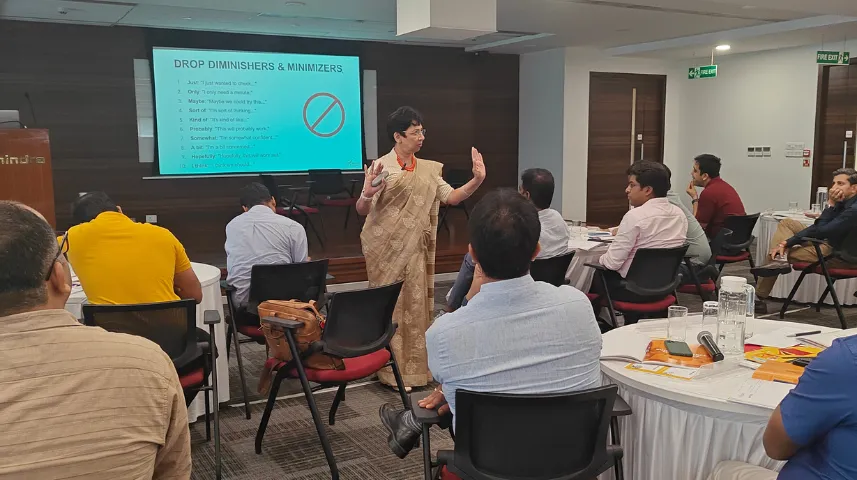
In coaching - both One-to-One and in Group settings - the assertiveness work consistently produces the most immediate and visible breakthroughs. Leaders discover that assertiveness, done well, does not damage relationships. It earns respect that deference never could.
Mastering Stakeholder Communication at the Board Level
Stakeholder communication at the senior level involves specific challenges that most leadership development programmes address incompletely:
- Presenting to a board that holds more power than you but knows less about your function - needing them to trust your judgment, not your data
- Aligning peers with competing priorities and limited patience for lengthy persuasion
- Managing upward - influencing a CEO or chairman whose attention is scarce and whose trust is earned
- Communicating in crisis - when the pressure to reassure clashes with the obligation to be honest
The common thread across all of these: audience-first preparation. Not 'what do I need to say?' - but ‘who is in this room, what do they actually care about, what are they afraid of, and how does my message speak to all of that?’
Building Communication Presence - The Physical Dimension
Communication presence is what you say plus how you say it plus how you occupy the room while you say it. Senior leaders who command rooms have worked on all three dimensions - pace, tone, volume, the strategic use of silence, eye contact quality, and the physical stillness that signals confidence.
These are coachable skills, not personality traits. And they compound rapidly — small, specific improvements in communication presence have outsized effects on how a leader is perceived across every professional interaction.
Frequently Asked Questions
Q: What is the most common communication mistake senior leaders in India make?
A: Over-explaining. Senior leaders with deep expertise have a tendency to provide full context, full reasoning, and full justification before arriving at their recommendation. At the CXO level, this reads as uncertainty. Lead with your position. Make your case concisely. Stop. The leaders who communicate with the most authority are often the ones who say the least.
Q: How is communication coaching different from a public speaking course?
A: Public speaking courses teach you how to present. Communication coaching works on the full spectrum of how you use language and presence to influence outcomes - one-on-one conversations, meetings, written communication, difficult conversations, and informal interactions where most leadership influence is actually built or lost. It is significantly more comprehensive and more practical.
Q: Can communication coaching help with written communication as well?
A: Absolutely. Many senior leaders invest in their verbal communication and neglect how their written communication - emails, proposals, strategic documents - affects how they are perceived at the organisational level. This is an area I address specifically in One-to-One Coaching.
Q: Does language fluency affect communication authority for Indian leaders?
A: Language fluency and communication authority are different things. Many of India's most commanding senior leaders are not native English speakers - and their authority comes from conviction, clarity of thinking, and the ability to speak to what their audience cares about. These qualities transcend language, and they are exactly what coaching builds.
Coach Samira Gupta is a Leadership Communication Coach in Delhi NCR working with India's senior leaders through One-to-One Coaching and Group Coaching. Build the communication presence your leadership demands.
Call: +91 9958934766 | Email: samira@auraaimage.com | Website: www.samiragupta.com