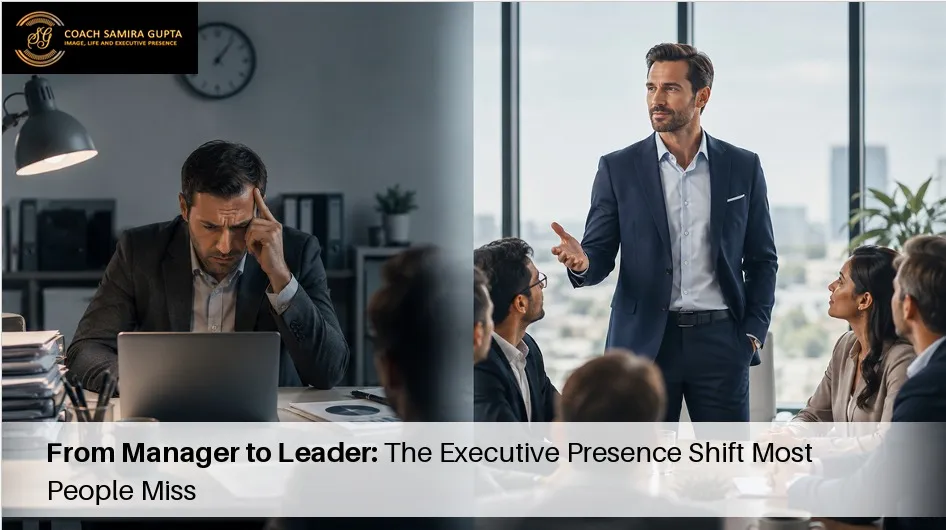
From Manager to Leader: The Executive Presence Shift Most People Miss
July 04, 2026
"Management is doing things right; leadership is doing the right things."
-- Peter Drucker
Every professional who has made, or is trying to make, the transition from manager to leader has encountered the same disorienting experience. The skills, habits, and presence that earned every promotion to this point suddenly feel insufficient.
What I have observed across two decades of coaching this exact transition is that the gap is rarely about technical capability. It is an Executive Presence gap. The way a manager carries authority in a room is simply not the way a room of senior stakeholders expects authority to be carried at the next level, and very few people are ever told this directly.
Why Presence Has to Be Rebuilt at Every Level
As a manager, composure often looks like staying calm while solving an operational problem under deadline. As a leader, that same composure needs to extend to remaining grounded while a room debates a strategy you do not fully control the outcome of. The underlying skill is related, but the level it has to operate at changes entirely.
Authority shifts in a similar way. A manager's authority comes largely from their formal role and their technical command of a function. A leader's authority increasingly depends on influence without direct control, the ability to move people and decisions across boundaries where no formal reporting line exists. This is precisely the dimension many newly promoted leaders have never had to develop, because their job title always did the work for them before.
And what counts as performance shifts too. A manager's performance is visible in the output of their function. A leader's performance becomes visible in the judgment, decisiveness, and presence demonstrated when the answer is not obvious and the stakes are organisational rather than departmental.
Where the Transition Most Commonly Breaks Down
- Continuing to lead with expertise rather than judgment, staying the most technically capable person in the room rather than building the influence to move people beyond direct expertise
- Retaining the composure of a manager under operational pressure without building the composure a leader needs under ambiguity and public scrutiny
- Failing to make the shift from personal output to enabling the output of others, which is the dimension boards and senior stakeholders actually watch for
In Group Coaching, this transition takes on a particular power because the cohort is made up of peers navigating the exact same shift. Honest conversation about exactly where the new level of presence feels hardest accelerates the transition in ways that individual reflection alone cannot.
Why Group Coaching Accelerates the Shift
The manager-to-leader transition is fundamentally a presence and perception shift, which makes it especially well suited to a group environment where peers can give real-time, credible feedback on how a leader's authority is actually landing in the room. This kind of feedback is rare in everyday organisational life and invaluable during a transition this consequential.
Frequently Asked Questions
Q: How do I know if I am stuck in the manager identity rather than fully leading?
A: A reliable signal is that your authority still comes entirely from your formal role rather than from influence across boundaries you do not control. If your standing in a room evaporates the moment you step outside your direct reporting line, the presence shift required for leadership has not yet happened.
Q: Is this transition only relevant for first-time leaders?
A: No. The transition happens at every level, from team lead to department head, from department head to VP, from VP to CXO. Each level requires rebuilding how you carry authority at a new scale, which is why senior leaders continue to benefit from Executive Presence coaching well into their careers.
Q: Why do technically excellent managers often struggle with this shift?
A: Because the qualities that produce technical excellence, precision and personal command of a function, can quietly crowd out the kind of influence that does not depend on direct expertise, which is exactly what the next level of leadership requires.
Q: How does Group Coaching specifically help?
A: It provides immediate, credible peer feedback on how your authority and composure are actually being perceived, which is feedback most senior leaders never otherwise receive, and it creates the social accountability that sustains the shift between sessions.
Navigating the manager-to-leader transition? Coach Samira Gupta works with India's emerging and senior leaders through Group Coaching and One-to-One programmes in Delhi NCR.
Call: +91 9958934766 | Email: samira@auraaimage.com | Website: www.samiragupta.com