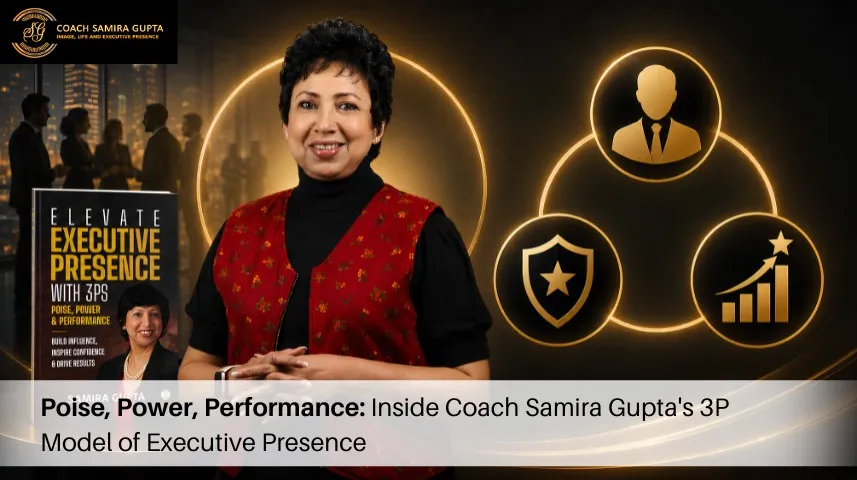
Poise, Power, Performance: Inside Coach Samira Gupta's 3P Model of Executive Presence
June 29, 2026
"Style is a way to say who you are without having to speak."
-- Rachel Zoe
In over 20+ years of coaching senior leaders across India, I have watched the same question surface again and again, in boardrooms, in coaching sessions, in the quiet moments after a meeting that did not go the way it should have. What is it, exactly, that makes one leader command a room while an equally capable leader struggles to be heard in the same room?
The answer, distilled from more than 2,500 hours of one-to-one coaching and 500-plus senior leaders across India's most respected organisations, became the foundation of my book, Elevate Executive Presence with 3Ps. I call it the 3P Model: Poise, Power, and Performance. It is the framework I now use with every leader who walks into my practice, and it is the model that anchors everything I teach about Executive Presence.
This is not a borrowed theory. It is built from two decades of watching what actually separates leaders who are respected from leaders who are merely competent.
Poise: The Foundation Beneath Everything Else
Poise is composure with intention. It is the quality that allows a leader to remain centred, clear, and dignified when the room gets difficult, when the question is hostile, or when the stakes are highest.
Poise is not the absence of pressure. It is the presence of self-possession in spite of it. I see this most clearly in coaching when a leader who has spent years reacting to challenge with defensiveness learns, often within a few sessions, to pause, breathe, and respond rather than react. The shift is visible immediately to everyone in the room, even though the leader has not said a single new thing. They have simply said it differently.
Poise draws on physical grounding, emotional regulation, and the kind of self-awareness that allows a leader to notice their own internal state before it leaks into their behavior. It is the part of Executive Presence most closely tied to what I call Appearance and Behavior in my coaching work: how you occupy a room before you have spoken a word.
Power: Owning Your Authority Without Apology
Power, in the 3P Model, is not about dominance. It is about the legitimate authority that comes from knowing your own value and communicating it without dilution.
This is the dimension I see most consistently underdeveloped in India's senior leaders, particularly those who have risen through technical excellence rather than overt self-promotion. They have power in the form of expertise, track record, and trust. What they often lack is the comfort of claiming it. They qualify their statements. They defer when they should hold ground. They let their results speak so quietly that the room moves on without registering them.
Power, properly developed, is the ability to take up the space your role and your capability have earned. It shows up in how directly you state a position, how you hold eye contact when challenged, and how comfortably you let silence do its work after you have made an important point. This is the dimension where Communication, the third pillar of my Executive Presence coaching, becomes inseparable from Power. You cannot project authority through words that constantly hedge themselves.
In coaching sessions, I often ask a leader to simply state their recommendation in one sentence, with no qualifiers, no apology, no immediate follow-up justification. For many senior leaders, this single exercise is the most uncomfortable and the most clarifying moment of our work together.
Performance: The Proof That Sustains the Presence
Performance is the third pillar, and it is the one that gives Poise and Power their credibility. Presence without delivery is theatre. Performance is what makes Executive Presence real rather than performed.
This is not simply about hitting targets. It is about consistently demonstrating, through results and through visible leadership behavior, that the poise and the power are earned rather than assumed. Performance is the track record that makes a room willing to grant a leader the benefit of the doubt in the next high-stakes moment.
The leaders I coach who integrate all three pillars most effectively are the ones who understand that Performance alone, without Poise and Power, leaves brilliant work under-recognised. And Poise and Power alone, without Performance, eventually ring hollow. The 3P Model only works as an integrated whole.
How the 3P Model Shows Up in Coaching
In my One-to-One Coaching practice, the 3P Model gives structure to what can otherwise feel like an abstract goal of building Executive Presence. Rather than working on vague notions of confidence, we work specifically on which of the three pillars is weakest for a given leader, and why.
A leader who is strong in Performance but weak in Power often needs work on assertive communication and reclaiming credit for their contributions. A leader strong in Power but weak in Poise often needs work on emotional regulation and physical presence under pressure. The model allows the coaching to be precise rather than generic.
Why This Framework Matters for India's Senior Leaders Specifically
India's corporate culture carries its own dynamics around hierarchy, deference, and visibility that make all three pillars uniquely challenging to develop. Poise must be built within a culture that often rewards emotional restraint to a fault. Power must be claimed within structures that can discourage open self-advocacy. Performance must be made visible in environments where credit does not always flow naturally to the person who earned it.
The 3P Model gives India's senior leaders a precise, learnable structure for navigating all three. It is the foundation of every Executive Presence engagement I run, from One-to-One Coaching to Group Training to the I Am Unlimited Leadership Retreat.
Frequently Asked Questions
Q: Is the 3P Model the same as general confidence-building?
A: No. Confidence is one input into the model, but the 3P Model is more specific. Poise is composure under pressure, Power is the legitimate claiming of authority, and Performance is the track record that sustains both. A leader can be confident and still be missing one of these three pillars entirely, which is why generic confidence coaching often falls short of building genuine Executive Presence.
Q: Which of the three pillars is most important?
A: All three are necessary, and the model is designed to work as an integrated whole. That said, in my coaching practice, Power is the pillar most frequently underdeveloped in technically excellent Indian senior leaders, because cultural conditioning around deference and humility often discourages the direct claiming of authority that Power requires.
Q: Can the 3P Model be applied in a Group Coaching or Retreat setting, not just one-to-one?
A: Yes. The model is used across all of my Executive Presence work, including Group Training sessions for leadership teams and the I Am Unlimited Leadership Retreat, where the Unstoppable Experiences are specifically designed to build the Poise and Power dimensions experientially, alongside the more reflective coaching work on Performance and personal narrative.
Q: How long does it take to see improvement using the 3P framework?
A: Most leaders see visible shifts in how they are perceived within 6 to 8 weeks of focused coaching using the 3P framework, particularly in the Poise and Power dimensions, which respond quickly to targeted behavioral work. The deeper integration of all three pillars into a leader's natural way of operating typically develops over 3 to 6 months.
Build your Executive Presence using the 3P Model, Poise, Power, Performance, with Coach Samira Gupta through personalised One-to-One Coaching in Gurugram, Delhi, and virtually across India.
Call: +91 9958934766 | Email: samira@auraaimage.com | Website: www.samiragupta.com