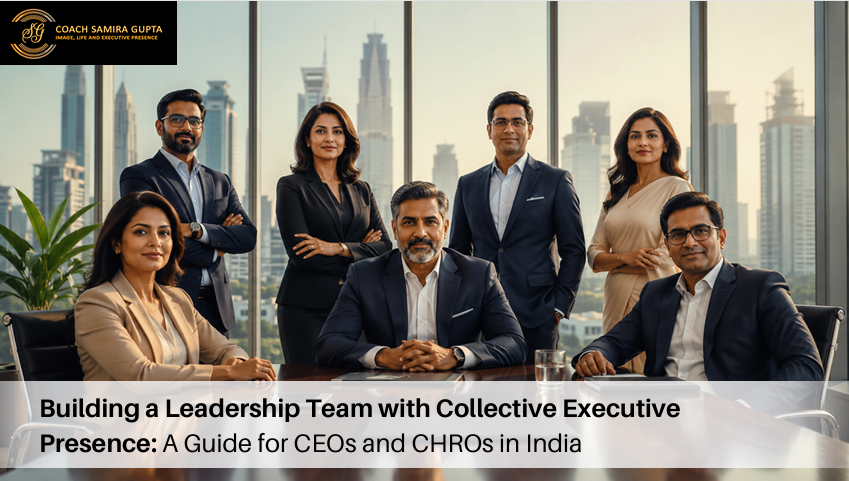
Building a Leadership Team with Collective Executive Presence: A Guide for CEOs and CHROs in India
July 14, 2026
"Talent wins games, but teamwork and intelligence win championships."
-- Michael Jordan
Ask any CEO in India what their single most important resource is, and the honest answer, for those operating with genuine strategic ambition, is their leadership team.
What I have learned coaching these teams across two decades is that individual presence in each member is necessary but nowhere near sufficient. A team of leaders who each individually come across well can still collectively project confusion, hesitation, or internal conflict to the rest of the organisation if those qualities are not aligned and reinforced as a shared standard.
What Collective Executive Presence Looks Like
A leadership team with genuine collective presence communicates a coherent sense of composure even under organisational pressure, exercises authority in ways that reinforce rather than undercut each other publicly, and demonstrates results that the rest of the organisation can clearly trace back to the team's shared decisions, not just to individual heroics.
Google's Project Aristotle, the most rigorous study of team performance to date, found that the single most important factor in team effectiveness was psychological safety, the shared belief that the team is safe for interpersonal risk-taking. This is, in essence, organisational composure: the ability to disagree and challenge each other without the team's presence fracturing in front of the wider organisation.
The Five Qualities of India's Best Leadership Teams
- Psychological safety, the team-level composure that allows honest disagreement without political fallout
- Shared standards for how authority and accountability show up across the leadership team, not just individually
- Productive conflict, where authority is exercised by multiple leaders without undermining each other's standing
- Collective accountability, where results are owned by the team as a whole, not deflected to whichever individual is most exposed
- A coherent external presence, where the rest of the organisation experiences one consistent leadership identity rather than competing signals
How Group Coaching Builds This
Group Coaching is one of the most effective tools for developing collective presence because it works on the team's shared dynamics directly. The work includes surfacing the unspoken norms that are quietly undermining the team's shared composure, building the psychological safety that allows honest challenge, and developing a common language for what strong authority and accountability look like at the team level, not just individually.
The I Am Unlimited Retreat as a Team Catalyst
For leadership teams ready for a more intensive intervention, the I Am Unlimited Leadership Retreat in Goa creates a shared experience of genuine depth. The Unstoppable Experiences, the peer coaching conversations, and the personal mastery work forge a collective composure and mutual respect for each other's standing that years of working together in the office do not always produce on their own.
Frequently Asked Questions
Q: How do I know if my leadership team has collective presence or just individually capable members?
A: A useful test is whether the organisation experiences one coherent leadership identity from the team, or whether different parts of the business get conflicting signals about priorities and standards. The latter usually signals that individual presence has not been aligned into a shared team standard.
Q: What is the CEO's role in building this?
A: The CEO sets the conditions, particularly the psychological safety, that allow collective composure to develop. If the CEO models defensiveness or punishes honest challenge, no amount of team coaching will be sufficient, since the team's culture is almost always a reflection of the leader's own presence.
Q: How long does it take to build collective Executive Presence in a leadership team?
A: Meaningful improvement is typically visible within three to six months of sustained Group Coaching. Building the full set of shared qualities, psychological safety, shared standards, and coherent external presence, typically requires twelve to eighteen months of consistent investment.
Q: Can Group Coaching work for teams that are already in visible conflict?
A: Yes, and it is often more important in these situations. Visible team conflict is usually a symptom of misaligned authority dynamics or unaddressed trust gaps, and skilled facilitation creates the conditions to surface and resolve these directly.
Coach Samira Gupta works with India's CEOs and CHROs to build leadership teams with strong collective Executive Presence through Group Coaching and the I Am Unlimited Leadership Retreat, Goa.
Call: +91 9958934766 | Email: samira@auraaimage.com | Website: www.samiragupta.com