Executive Presence for Women Leaders in India: Owning the Room Without Losing Yourself
August 14, 2026
A woman who owns her authority does not need to raise her voice to be heard. She simply needs to be fully present.
-- Coach Samira Gupta
If you are a senior woman leader in India, you are probably running a calculation right now that your male peers are not running.
How do I claim this space without being seen as too aggressive? How do I disagree with this person without damaging the relationship it took two years to build? How do I communicate this expertise clearly without triggering the dynamic where a man in the same room says the same thing and is simply heard as confident?
You are running this calculation in meetings, in performance conversations, in the moments before you speak up in a room where your voice is not the most expected one. And it is exhausting. Not because you are uncertain. But because the calculation is real, it is rational given the environments many senior women in India actually navigate, and it costs an enormous amount of cognitive energy that could be going into actually leading.
This piece is about getting out of that calculation. Not by pretending the dynamics that make it necessary do not exist. But by building the kind of authority that eventually makes the calculation unnecessary.
The Double Standard, Named Directly
The research on this has been consistent for decades. The same assertive communication style that reads as confident and authoritative in a male leader is frequently coded as aggressive or difficult in a female one. The same willingness to hold a position under challenge that earns a man the label decisive earns a woman the label stubborn.
In Pune's traditional manufacturing and automotive cultures, these dynamics are often explicit and rooted in generational norms around gender and seniority. In Bengaluru's meritocracy-oriented technology sector, they are often informal and invisible -- the startup culture that claims to value only capability and yet consistently produces senior leadership teams that are overwhelmingly male. In Delhi NCR's conglomerate and financial services environments, they play out in the specific ways authority is acknowledged and credit is distributed in senior forums.
I want to be direct: the difficulty of building Executive Presence as a senior woman in India is not a personal failing. It is not a confidence problem. It is a structural reality. And the most effective response to a structural reality is not to push through it harder. It is to build something powerful enough to navigate it.
Three Capabilities That Change the Dynamic
Assertiveness That Does Not Need to Be Loud
There is a specific form of assertiveness I help senior women develop that is culturally intelligent rather than culturally imposing. It does not try to out-volume or out-aggress the dominant register in the room. It simply holds a position with such clarity and conviction that the room has to engage with it on its merits.
This looks like stating the recommendation without a preamble of qualifiers. Disagreeing with specificity rather than apology. Declining an inappropriate request with a directness that communicates certainty rather than seeking permission. It is a behavioral skill. In my coaching work with senior women in Pune's corporate sector and in Bengaluru's technology companies, it is consistently the capability that produces the most immediate and visible change in how a leader is received by the rooms around her.
Occupying Physical Space as a Leadership Act
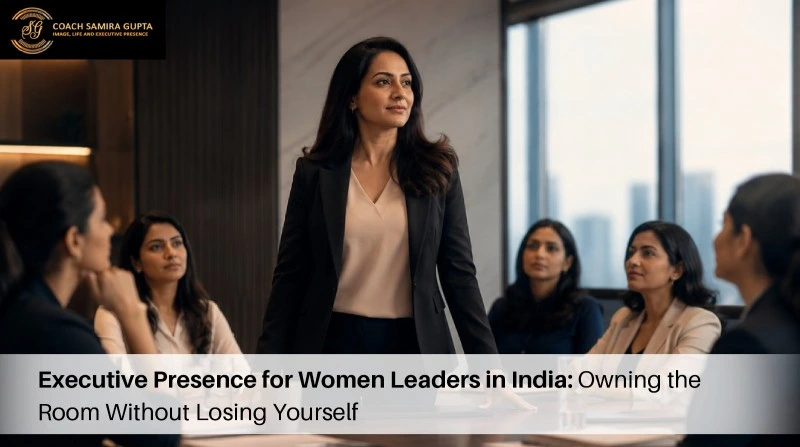
Women leaders across every city I work in -- in Delhi's corporate headquarters, in Mumbai's financial sector, in Pune's executive suites, in Bengaluru's boardrooms -- consistently under-occupy their physical space in professional settings. Sitting at the edge of the chair rather than the full width. Speaking more quietly than the room requires. Positioning the body in ways that signal deference before a word is spoken.
Developing the physical presence to occupy a room fully is one of the fastest-acting and most impactful presence changes I work on. And it is powerful precisely because it operates before language, before content, before any of the other qualities that matter -- it shifts how you are read before you have said a single word.
Separating Worth From Approval
The calculation described at the beginning of this piece comes from a specific underlying belief: that authority and likeability are in competition, and that claiming one necessarily costs the other. This belief is understandable. It also quietly governs decisions -- how forcefully to state a position, whether to push back, whether to take up the space a role has earned -- in ways that erode presence over time.
The women leaders who develop the strongest and most sustainable Executive Presence are those who have stopped trying to be liked by every person in every room and started focusing on being respected by the right people in the right rooms. These are not the same goal. Likeability is often given. Respect is always earned. And the path to earning it is through consistent, composed, clearly-held authority.
The most consistent shift I see in coaching senior women leaders across India is this: a leader stops trying to manage how she is perceived and starts trusting that her genuine capability, expressed with composure and clarity, is sufficient. It always is. The room adjusts.
The Permission Piece
Here is what I have observed, without exception, in the senior women leaders I have coached across India -- in Pune, in Bengaluru, in Delhi, in Mumbai, in Hyderabad.
The capability is already there. The assertiveness, the strategic thinking, the composure under pressure, the quality of judgment -- these are present. What is missing is the internal permission to express them fully in the rooms that matter most.
That permission is not given by the organisation, by peers, or by the industry. It is given by the leader herself. And it is, in my experience, the most important shift that Executive Presence coaching facilitates -- not the communication techniques or the physical presence adjustments, but the moment a leader stops asking whether she is allowed to take up this space and simply takes it.
Frequently Asked Questions
Q: Is this coaching specifically for women, or can it be done alongside other coaching programmes?
A: The coaching is tailored to the specific presence challenges that senior women leaders in India navigate, which are genuinely distinct from the challenges their male peers face. It can be done as a standalone engagement or alongside other development work.
Q: I work in a relatively progressive organisation. Are these dynamics still relevant for me?
A: Yes, though they present differently. In more progressive organisations, the double standards are often subtler and less visible, which can make them harder to name and harder to address. The calculation -- how do I claim authority without triggering a negative reaction -- exists across most Indian corporate environments, just in different registers.
Q: Is the coaching different for women leaders in Pune versus those in Bengaluru or Delhi?
A: The underlying capabilities developed are the same, but the cultural dynamics in which they need to operate differ significantly. Pune's traditional corporate cultures, Bengaluru's startup ecosystem, and Delhi NCR's conglomerate and financial environments each have their own dynamics around gender and authority. The coaching addresses your specific context explicitly rather than applying a one-size-fits-all model.
Q: How do I develop assertiveness without being perceived as aggressive?
A: The key is developing assertiveness that is culturally intelligent rather than culturally imposing -- holding a position with genuine conviction and specificity, without the emotional charge that reads as aggression. This is a precise behavioral skill that responds well to focused coaching and that looks and sounds different in Pune's corporate culture versus Bengaluru's startup environment versus Delhi's conglomerate sector.
Q: What is the most important first step for a senior woman who wants to build stronger Executive Presence?
A: Becoming more accurate about where the gap actually is. The coaching always starts with honest data about how you are currently experienced by the rooms that matter -- which patterns are reading as authority, and which are inadvertently signalling something else. That diagnostic is the foundation everything else is built on.
Ready to build Executive Presence that is powerful, authentic, and yours? Coach Samira Gupta works with senior women leaders across India through personalised One-to-One Coaching.
Call: +91 9958934766 | Email: samira@auraaimage.com | Website: www.samiragupta.com