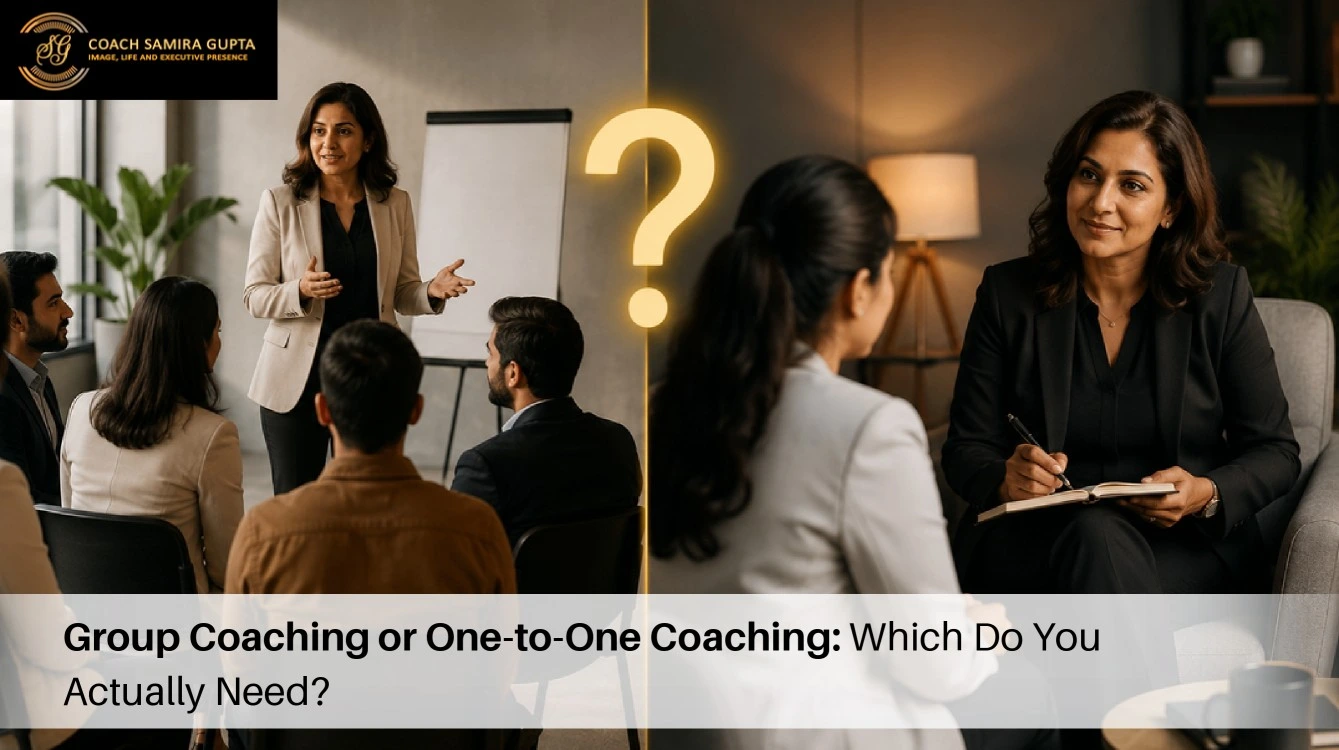
Group Coaching or One-to-One Coaching: Which Do You Actually Need?
August 12, 2026
L&D heads and senior leaders in Gurugram ask me this question regularly: we have someone who needs development. Should they be in individual coaching or a group programme?
My answer is almost always: it depends on what you are trying to change.
This is not a dodge. Group Coaching and One-to-One Coaching are genuinely different executive coaching programmes that develop different things. Getting the choice wrong does not mean a leader will get nothing from the experience -- but it does mean they will get significantly less than they could have. In organisations where development budgets are real and time is genuinely scarce, that matters.
Start Here: One Diagnostic Question
Is the development need primarily internal, or primarily relational?
Internal development needs -- a limiting belief about authority, a specific communication habit in senior forums, the pattern of hedging every recommendation -- are best addressed in One-to-One Coaching. The work is personal, private, and requires honest examination that most people cannot do in front of peers. The coach creates the conditions. The leader does the work in a confidential space.
Relational development needs -- how a leader's presence actually lands on other people, whether their authority reads clearly in a room, how their communication is received rather than how they experience delivering it -- are where Group Coaching is irreplaceable. You cannot practice presence in isolation. Presence is only visible in relation to others, and feedback from a coach is qualitatively different from feedback from respected peers watching in real time.
When One-to-One Coaching Is the Stronger Choice
In my practice in Gurugram, One-to-One Coaching produces its strongest outcomes in these situations:
- A leader stepping into a significantly larger role who needs rapid, targeted development in a specific capability before an upcoming board interaction or stakeholder presentation
- A leader whose development need involves belief structures or identity patterns genuinely best examined in confidence -- the impostor pattern, the perfectionism preventing delegation, the internal story capping presence
- A leader in an organisation where political dynamics make genuine openness in a group setting professionally risky
- A leader who needs precise behavioral change in a narrow, specific context -- composure with a particular type of stakeholder, or communication in a particular kind of high-pressure forum
When Group Coaching Is the Stronger Choice
Group Coaching does something no amount of individual coaching can replicate: it tells a leader how they actually land on other people.
A coach can observe and describe patterns. Peers who are watching in real time, in conditions that activate real social stakes, provide a qualitatively different and often more credible form of feedback. When a leader who has been told in individual sessions that they come across as hesitant sees it reflected back by eight respected peers in a group session, the insight lands differently. It becomes undeniable rather than theoretical.
Group coaching executive programmes in Gurugram's leadership teams are also particularly effective when the need is collective -- when a leadership team needs to develop shared standards of Executive Presence and communication rather than developing individually in isolation.
The Case for Using Both
The most effective development trajectories I see for senior leaders in Gurugram almost always involve both formats, used in sequence or in parallel. One-to-One Coaching builds the underlying capability. Group Coaching tests whether that capability holds up under real social pressure.
A leader who develops composure under challenge in individual coaching, and then practices holding that composure in front of eight respected peers, is doing the most complete version of the development work. Each executive coaching programme amplifies what the other produces.
The question I ask when a leader cannot decide: are you trying to build something, or make sure what you are building actually holds up when it counts? The first points to One-to-One. The second is where the group becomes essential.
A Practical Decision
Choose One-to-One Coaching if the development need is specific, time-pressured, or requires a level of privacy a group cannot provide. Choose Group Coaching if the need is primarily about how you show up in relation to others and you would benefit from honest feedback from peers who understand the context. If you are genuinely unsure, start with a conversation. The right executive coaching programme is always the one that fits the actual situation.
Frequently Asked Questions
Q: How do I know if I need coaching at all, versus a training programme?
A: Training delivers content to a group and produces awareness. Coaching creates behavioral change through precise, feedback-driven practice on your specific patterns in your specific context. If the goal is skill acquisition, training may be sufficient. If the goal is changing how you show up -- in presence, in communication, in how you are perceived by senior stakeholders -- coaching is the right tool.
Q: Are these executive coaching programmes available for leaders based in Gurugram specifically?
A: Yes. Coach Samira Gupta's practice is based in Gurugram and both One-to-One Coaching and Group Training are available to leaders across the Gurugram and Delhi NCR corridor, as well as virtually to senior professionals across India.
Q: What if I start with One-to-One Coaching and want to add Group Training later?
A: This is actually a common and effective sequence. Leaders who have done focused individual work on a specific pattern find that Group Training then tests and reinforces the change under real social conditions, sustaining the improvement beyond the individual coaching relationship.
Q: How does an organisation decide between funding individual or group coaching for a leadership team?
A: For teams where individual leaders have specific, different development needs, individual coaching is more efficient. For teams where the need is shared -- all stepping into new seniority levels simultaneously, or all needing stronger Executive Presence as a collective -- Group Training is more cost-effective and often produces faster cultural change across the team.
Not sure which programme fits your situation? Coach Samira Gupta offers both One-to-One Coaching and Group Training in Gurugram and across India. Start the conversation.
Call: +91 9958934766 | Email: samira@auraaimage.com | Website: www.samiragupta.com