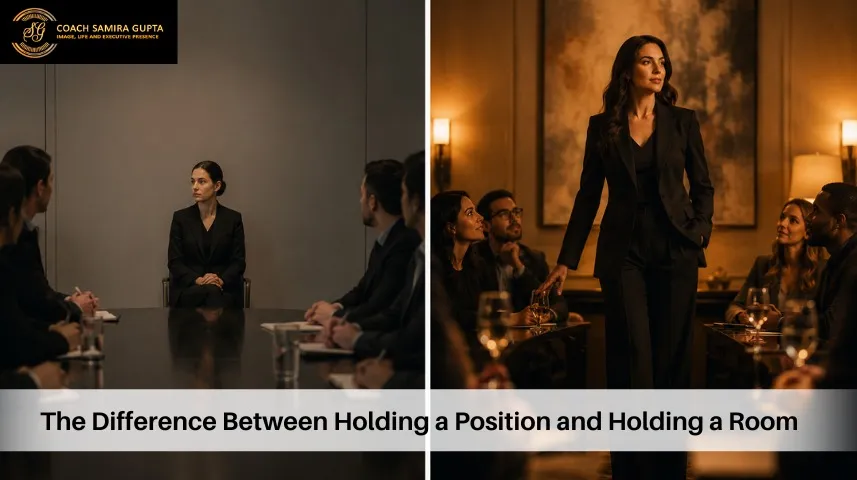
The Difference Between Holding a Position and Holding a Room
July 07, 2026
"Authority may get people to listen, but presence is what makes them remember."
-- Coach Samira Gupta
Walk into any meeting room, and you will notice something interesting.
There are people with impressive titles, years of experience, and decision-making power. Yet when they speak, the room does not always respond. Then there are others who may not hold the highest position in the hierarchy, but when they speak, people pay attention. Conversations shift. Energy changes. Decisions move forward.
This is the difference between holding a position and holding a room.
Too many professionals spend decades acquiring titles and designations that will make them more important and more influential. But no matter how impressive those accomplishments are, there are times when having a position is no substitute for having the ability to command respect and create genuine impact. Recognising this simple truth can change everything about your approach to leadership.
What Does It Mean to Hold a Position?
Holding a position refers to the authority that comes from a role, title, or designation within an organisation. A CEO, department head, team leader, or manager holds a position because the organisation has formally given them that responsibility and authority. Their role allows them to make decisions, allocate resources, approve projects, and guide teams.
A position offers:
- Formal authority within an organisation
- The power to make decisions
- Responsibility for defined results
- Acknowledgement of expertise or experience
There is nothing wrong with having a position. Organisations require such structure and leadership to function effectively. The challenge arises when people assume that a position alone is enough to create influence. Many leaders discover that while their title gives them authority, it does not automatically earn them trust, respect, or genuine engagement from others.
What Does It Mean to Hold a Room?
Holding a room is completely different. It means having the ability to capture people's attention and make your presence felt wherever you go. When someone holds a room, people naturally turn their attention toward them, not because of an external compulsion or a formal authority structure, but because of an internal draw they cannot quite explain.
This is closely related to Executive Presence, effective leadership communication, and the ability to influence people in the workplace. It cannot be handed to you through a promotion letter.
You have probably experienced this yourself. Perhaps you have attended a meeting where one person spoke calmly and confidently. They were not the loudest voice in the room, nor were they trying to dominate the discussion. Yet everyone seemed drawn to what they were saying.
That is what holding a room looks like. It is less about authority and more about impact.
Leaders with Authority but Limited Influence: Why Does This Happen?
This pattern occurs frequently in contemporary organisations. People spend decades honing the technical and business skills that qualify them for senior positions. Yet very few invest equivalent time in building leadership presence.
As a result, certain leaders depend almost entirely on their authority to command compliance. They believe that people must listen simply because of the hierarchy. The reality is that while authority drives compliance, influence creates commitment. People may follow instructions because they have to. But they follow leaders because they want to.
When leaders depend solely on their position, they often face challenges such as:
- Limited engagement from team members
- Reduced trust and openness in communication
- Difficulty inspiring meaningful change
- Lower levels of collaboration across functions
- Resistance during periods of uncertainty or transformation
In contrast, leaders who hold a room are able to navigate these situations more effectively because they have built credibility that extends well beyond their title.
The Traits of People Who Hold a Room
If holding a room is not about hierarchy, what creates it? While there is no single formula, certain qualities consistently stand out.
They Listen Before They Speak
People who command a room are often excellent listeners. Rather than rushing to prove their expertise, they take the time to understand the conversation. They ask thoughtful questions and respond with intention. This makes others feel heard, which naturally and consistently increases their influence.
They Project Calm Confidence
Confidence does not mean having all the answers. Some of the most influential leaders are completely comfortable admitting when they do not know something. Their confidence comes from self-awareness rather than certainty. This calmness becomes especially valuable during high-pressure situations when others are looking for reassurance.
They Communicate with Clarity
People who hold a room understand the value of simplicity. They avoid unnecessary jargon and complicated explanations. Instead, they communicate ideas in a way that people can easily understand and remember. Clear communication consistently creates more impact than an impressive vocabulary.
They Make Others Feel Important
One of the most overlooked aspects of influence is the ability to make others feel valued. Leaders who hold a room do not constantly seek attention. Instead, they create an environment where others feel comfortable contributing. Ironically, this often increases their own influence rather than diminishing it.
Position Gives Permission. Presence Creates Impact.
One of the biggest misconceptions in leadership is believing that authority automatically creates influence. The truth is that position gives you permission to lead. Presence determines whether people choose to follow.
Think about the leaders you have admired throughout your career. Chances are you remember them not because of their title but because of how they made people feel. You remember their confidence during difficult moments. You remember their ability to communicate clearly. You remember the trust they built. Their influence extended far beyond their position.
That is the power of Executive Presence.
Position gives you the room. Presence gives you the room's attention. Both matter, but only one can be developed from the inside out.
Can You Influence a Room Even Without a Position of Authority?
Yes, and it happens more than most people realise. In many organisations, the most influential individuals are not always in leadership roles. They can be project managers, team members, consultants, or subject matter experts. Their ideas are heard because of the credibility and presence they have built, not because of what is printed on their business card.
This is particularly motivating for professionals who are still building their careers. Being in a position of authority is not always necessary to create influence. There are many ways to hold a room even when you are not formally in charge, and building that capability early is one of the most valuable investments a professional can make.
How to Develop the Ability to Hold a Room
Executive Presence is not something you are born with. It can be developed intentionally, with the right coaching and the right commitment.
Focus on Self-Awareness
Understand how others experience you. The gap between how we see ourselves and how others actually perceive us can be surprisingly large. Seeking structured feedback and working with a coach can provide the honest insights that self-reflection rarely delivers on its own.
Improve Your Communication Skills
Strong communication remains one of the most powerful tools for influence. Focus on clarity, conciseness, active listening, and the ability to tell a story that moves people rather than simply informs them.
Become Comfortable with Silence
Many professionals feel pressured to fill every pause. But people who hold a room understand the power of silence. A thoughtful pause can create more impact than speaking continuously, because it signals that what you are about to say has been considered rather than simply reacted to.
Lead Through Consistency
Trust is built over time. When your actions consistently align with your words, people begin to see you as credible and dependable. That credibility is the foundation on which genuine presence is built.
Why This Matters More Than Ever in 2026
The modern workplace is evolving at a fast pace. Diverse teams, complex communication, and the shift away from traditional command-and-control leadership toward influence and relationship management are creating a landscape where hard skills alone are not sufficient.
It is the professionals who can communicate effectively, earn genuine trust, and make people feel something in a room who make the biggest difference in organisations today. This is precisely why Executive Presence, leadership influence, and professional presence are no longer considered optional extras at the senior level.
Holding a room is not a soft skill. It is a strategic leadership capability.
Conclusion
Holding a position and holding a room are not the same thing. A position may give you authority, but presence gives you influence. A title may open doors, but credibility, communication, and connection determine what happens once you are inside.
The most effective leaders understand that true influence is not granted through hierarchy. It is earned through the way they show up, communicate, and make others feel.
Because at the end of the day, people may respect your position. But they remember your presence.
Frequently Asked Questions
Q: What is the difference between holding a position and holding a room?
A: Holding a position refers to formal authority within an organisation, such as a title or designation. Holding a room refers to the ability to influence, engage, and command attention through presence and communication, regardless of your formal role.
Q: Can Executive Presence be learned?
A: Yes. Executive Presence can be developed through self-awareness, communication skills, confidence, credibility, and consistent leadership behavior. Working with an experienced Executive Presence coach significantly accelerates the process.
Q: Why is Executive Presence important for leaders?
A: Executive Presence helps leaders build trust, influence decisions, inspire teams, and communicate effectively, particularly in high-stakes situations where authority alone is not enough to carry the room.
Q: Is influence more important than authority?
A: Both matter, but influence often creates stronger engagement and commitment because people choose to follow rather than simply comply. The most effective leaders combine both, using their position to open the door and their presence to create genuine impact once inside.
Q: How can I improve my leadership presence?
A: Focus on active listening, clear communication, self-awareness, confidence, and building trust through consistent actions. Consider working with an Executive Presence coach who can provide structured feedback and a precise development roadmap tailored to your context.
Ready to stop relying on your title and start commanding the room? Work with Coach Samira Gupta, Executive Presence Coach in Gurugram, through personalised One-to-One Coaching or join the I Am Unlimited Leadership Retreat in Goa. Only 20 seats available.
Call: +91 9958934766 | Email: samira@auraaimage.com | Website: www.samiragupta.com