Hyderabad Senior Leaders Have Two Audiences. Most Are Only Reaching One.
July 24, 2026
HITEC City is home to the Indian operations of Microsoft, Google, Amazon, and over 1,500 multinational companies. The leaders running these operations are, by almost every professional measure, exceptional. Many manage teams across four or five countries. Many have delivered results that would earn respect in any corporate environment on earth.
And yet, in Hyderabad's leadership conversations, one specific gap keeps surfacing -- in discussions with CHROs, in feedback from global stakeholders, and in the quiet frustration of leaders who know they are capable of more than the rooms they are currently reaching.
The gap is not technical. It is not strategic. It is a presence gap, specifically the ability to project authority convincingly across two very different professional cultures simultaneously.
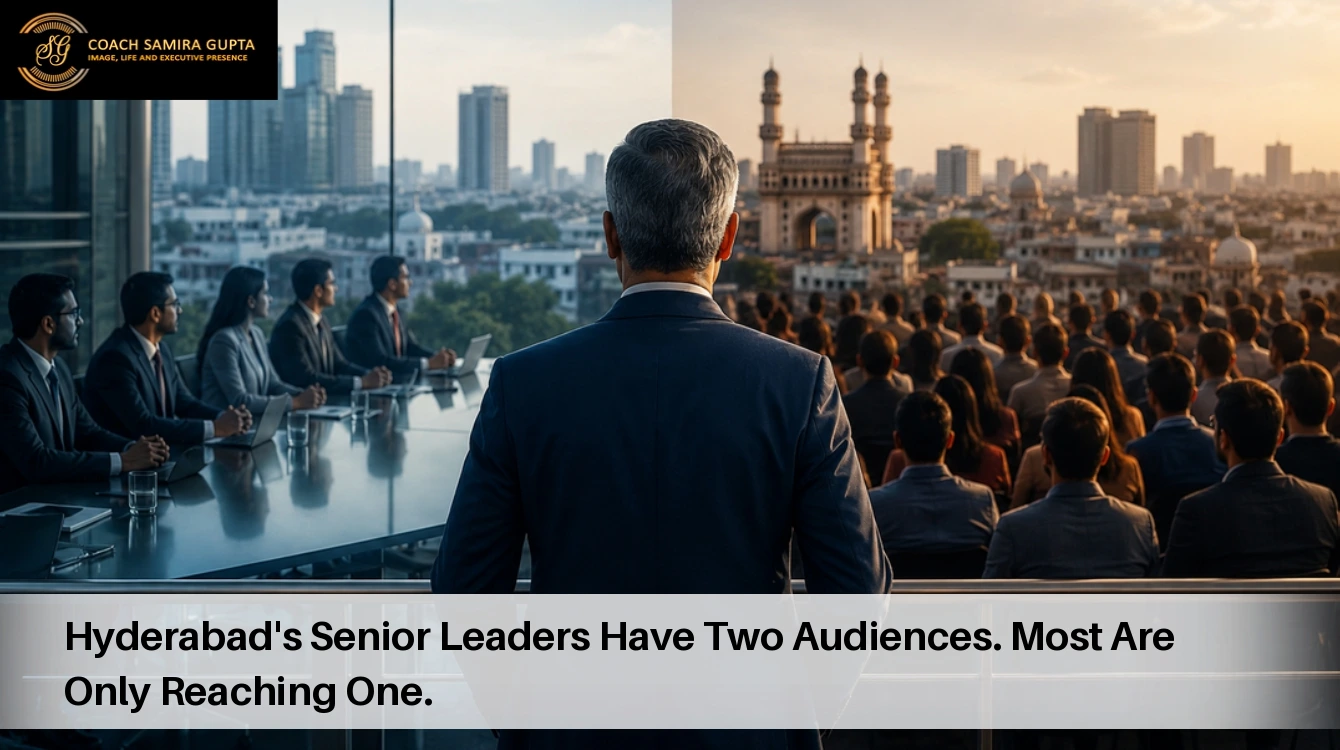
The Two-World Problem
A senior leader in Hyderabad typically operates across two cultural registers in a single working day. In the first, they are leading a local team where relationship-orientation, deference to seniority, and the collegial warmth of South Indian professional culture are not just comfortable but genuinely valued. In the second, they are on a call with a global stakeholder in Amsterdam or Austin who expects assertiveness, brevity, and self-positioning that signals readiness for international leadership.
Neither register is wrong. Both are legitimate professional cultures. The problem is that most leaders in Hyderabad have learned to operate fluently in one and are performing uncomfortably in the other, usually without knowing it, and almost always without anyone having told them directly.
The result is visible in specific ways. A leader who is deeply respected within their Hyderabad team is repeatedly passed over when global roles are discussed. A technically excellent professional gets described as not quite ready by a global stakeholder who cannot articulate exactly why. A leader who commands a room locally finds themselves speaking less than intended and qualifying more than they wanted on calls with international peers.
Where the Gap Shows Up Most Clearly
The Global Leadership Call
International calls run fast. The cultural norm in most global leadership environments is directness: state your position early, hold it clearly, and engage challenge without softening the response excessively. For a leader conditioned by years of operating where this directness would read as disrespectful, the adjustment is significant. And it is not simply about communication style. It is about the physical and vocal presence that projects authority in a compressed, high-speed video format where silence reads as absence and qualification reads as uncertainty.
The Promotion Conversation
Global promotions in Hyderabad's MNC sector are frequently decided in conversations the leader is not part of. A global decision-maker forms an impression across three or four formal interactions. In each, they are judging not just the leader's work but whether this person projects the quality of authority that the next role requires. This judgment is fast, often unconscious, and heavily influenced by presence signals that have nothing to do with technical capability.
The Stakeholder Visit
When a global stakeholder visits Hyderabad, the senior leaders who make the strongest impression are those who communicate with the economy and directness that international business culture expects while demonstrating the relationship depth that makes Hyderabad's operations genuinely valuable. This combination is rare. It is also learnable.
Closing the cross-cultural presence gap does not require becoming less Indian or less warm. It requires adding range. The leaders who develop it find that their influence expands in both directions -- more credible globally and more effective locally.
What the Development Actually Involves
For Hyderabad's senior leaders, Executive Presence coaching focuses on three specific capabilities: communicating with economy and directness in international contexts without losing the relationship intelligence that makes Hyderabad's leaders trusted; physical and vocal calibration that projects authority on video calls specifically; and the assertiveness to state and hold a position in forums that actively reward it.
The work is always grounded in the actual situations the leader faces, the actual global stakeholders they navigate, and the specific moments where the gap currently opens.
Frequently Asked Questions
Q: I have worked in MNCs for years. Why would I still have a presence gap with global stakeholders?
A: Familiarity with a multinational environment is different from having been coached specifically on the presence signals that international leadership contexts reward. Most leaders in Hyderabad's MNC sector have adapted informally over time, but informal adaptation rarely closes the gap as precisely as targeted coaching at the senior leadership level, where the stakes of each high-visibility interaction are at their highest.
Q: How is this different from cross-cultural training?
A: Cross-cultural training teaches you about differences. Executive Presence coaching helps you operate fluently across them. The coaching is behavioral, not informational -- it works on the specific communication patterns, physical presence signals, and assertiveness habits limiting your authority in specific contexts.
Q: Can this coaching be done virtually for leaders based in Hyderabad?
A: Yes, and virtual coaching is particularly effective here because much of the work involves precisely the skills needed for high-stakes video calls -- vocal pace, camera presence, clarity under time pressure, and projecting authority through a screen.
Q: Does the coaching address hierarchy and deference dynamics specific to South Indian professional culture?
A: Yes explicitly. The coaching does not try to remove cultural conditioning that is genuinely valuable. It works on building range -- the ability to move between a hierarchical-relationship context and a direct-assertiveness context so that neither suppresses the other when it should be active.
Q: Can this coaching help with promotion conversations for global roles?
A: Specifically yes. Many Hyderabad-based leaders engage in coaching precisely because they are shortlisted for a global role and want to ensure their presence in the surrounding conversations reflects the capability they have already demonstrated in the work.
Ready to build Executive Presence that works across both worlds? Coach Samira Gupta works with senior leaders in Hyderabad through personalised One-to-One Coaching.
Call: +91 9958934766 | Email: samira@auraaimage.com | Website: www.samiragupta.com