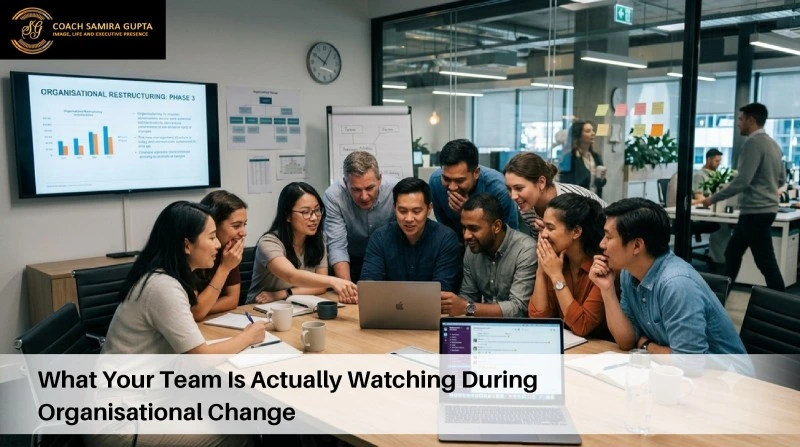
What Your Team Is Actually Watching During Organisational Change
August 13, 2026
Anyone can hold the helm when the sea is calm. Leadership is visible in the storm.
-- Coach Samira Gupta
A senior leader at a large Delhi-based conglomerate was in the middle of a significant restructuring. She had prepared a careful communication plan. She had briefed her team thoroughly. She had said, clearly and with conviction, all the right things about the direction and the rationale.
Two weeks later, a trusted direct report told her quietly: the team knows you are worried.
She had not said she was worried. But they knew.
This is the central truth about leading through change that most communication plans miss entirely. In periods of genuine uncertainty, people stop processing what their leaders say. They start reading how their leaders are. And the gap between those two things -- between what a leader communicates and what a leader projects -- is where trust is won or lost.
What Teams Are Actually Reading
Senior leaders across Delhi's conglomerate sector, Hyderabad's global MNCs, and Mumbai's financial organisations all face the same dynamic when change arrives. The team cannot always articulate what has shifted in their leader's manner. But they are picking up signals with remarkable accuracy from micro-expressions, the pace of speech under pressure, the quality of eye contact, and whether the leader is genuinely present in conversations or slightly elsewhere.
Is the leader actually calm, or performing calm? Does the leader genuinely believe in the direction, or are they delivering a message they have been asked to deliver? Teams answer these questions through instinct and accumulated observation. Their answers determine whether they follow with commitment or simply comply while quietly looking for other options.
As a Leadership Coach in Delhi working with senior leaders through periods of organisational transformation, I have observed one consistent pattern: the leaders whose teams remain engaged are not always those with the best strategy or the clearest communication plan. They are the ones whose presence is genuinely stable rather than performed.
The Five Presence Qualities That Hold Trust Through Change
Honest Uncertainty, Held Without Anxiety
The most damaging thing a leader can do during change is tell the team everything is fine when it visibly is not. The gap between the message and the observable reality destroys credibility faster than any difficult truth would. The leaders who maintain trust are those who can say what they know, name clearly what they do not yet know, and communicate both from genuine composure rather than managed performance. This is harder than it sounds. It requires being internally regulated -- not just appearing regulated.
Physical Signals That Match the Words
In Delhi's corporate environments, where senior teams have sophisticated political instincts, non-verbal signals carry enormous weight. Posture under pressure. The steadiness of eye contact. The pace of speech when the room is uncertain. The ability to sit in a difficult conversation without the physical restlessness that signals internal anxiety. These are the evidence teams use to determine whether verbal composure is real. Non-verbal signals are processed before language, trusted more than language, and remembered longer than language.
Visible Presence During the Uncertainty
During change, invisible leaders are interpreted as leaders who are in trouble. Leaders who retreat into strategy work, who are harder to reach, who seem distracted in conversations, are communicating through their absence that the situation is more serious than their words suggest. The leaders who hold trust increase their visibility and the quality of their attention during change -- not through more formal communications but through the quality of presence they bring to individual interactions.
Decisions Made Clearly and Owned Fully
Teams can tolerate imperfect decisions. They cannot tolerate leaders who appear unable to make them, or who make a call and then begin hedging it in response to challenge. The ability to decide clearly, communicate the reasoning honestly, and hold the decision without excessive qualification is one of the most visible Executive Presence qualities teams look for during change. In Hyderabad's global organisations and in Mumbai's fast-moving financial sector, this decisiveness under ambiguity is what makes people stay rather than start exploring options.
Consistent Behavior Toward People
How a leader treats people who are uncertain, anxious, or underperforming during change is one of the most watched dimensions of leadership presence. The leaders whose teams retain their loyalty through restructuring are those who demonstrate through their actual behavior -- not through announcements -- that the standards of how people are treated remain in place regardless of the pressure the leader is under. This consistency is noticed immediately and remembered long after the change is complete.
In Group Coaching during change, one of the most consistently valuable discoveries is that every leader in the room is navigating a version of the same isolation. The change that feels uniquely difficult is usually shared. Working through how to lead it together accelerates what individual reflection cannot.
Frequently Asked Questions
Q: My team says they trust me but engagement is dropping during this change. What is happening?
A: Engagement and trust are different things. A team can trust a leader's intentions while disengaging from the direction because their confidence in the outcome is low, or because they are picking up non-verbal signals from the leader that contradict the verbal message. Engagement during change depends not just on trust but on the specific presence qualities -- visible composure, accessible leadership, clear decision-making -- that make people feel the situation is in capable hands.
Q: How is this different from crisis leadership?
A: Crisis leadership involves immediate response to a known threat. Leading through change involves sustained presence over a longer, more ambiguous period where the team's anxiety accumulates over time. The presence qualities required are related but the duration and challenge of maintaining composure over weeks or months rather than hours makes change leadership its own distinct capability.
Q: Is Group Coaching useful for leadership teams in Delhi NCR going through restructuring?
A: Very much so. Restructuring is isolating for senior leaders precisely because they are expected to project certainty to their teams while privately navigating significant uncertainty. Group Coaching creates a rare space for honest peer conversation about what they are actually experiencing, which both provides perspective and builds collective capability to lead through the change more effectively.
Q: How quickly can Executive Presence coaching help during an active change process?
A: Certain specific capabilities -- particularly communicating honest uncertainty clearly and improving physical composure signals -- can show visible improvement within a few coaching sessions. The coaching does not require a long lead time to be useful during an ongoing change process.
Q: Does this apply to leaders in industries going through disruption, not just internal restructuring?
A: Yes. The same presence qualities that hold trust during internal reorganisation are equally critical when an industry is being disrupted -- Hyderabad's pharmaceutical sector navigating regulatory change, Mumbai's financial sector absorbing fintech disruption, or Delhi's media organisations transforming their business models. The presence challenge is the same: remain genuinely stable while communicating honest uncertainty.
Leading through a period of change? Coach Samira Gupta is a Leadership Coach working with senior leaders and teams across Delhi, Hyderabad, Mumbai, and India through One-to-One Coaching and Group Training.
Call: +91 9958934766 | Email: samira@auraaimage.com | Website: www.samiragupta.com