Why Group Coaching Builds Executive Presence Faster Than Individual Training Alone
July 09, 2026
"Alone we can do so little; together we can do so much."
-- Helen Keller
There is a particular irony in how most organisations approach Executive Presence development. Presence is, by definition, judged by other people, in front of other people. And yet the default investment is almost always individual: one-to-one coaching for key leaders, working in isolation on a quality that only ever shows up socially.
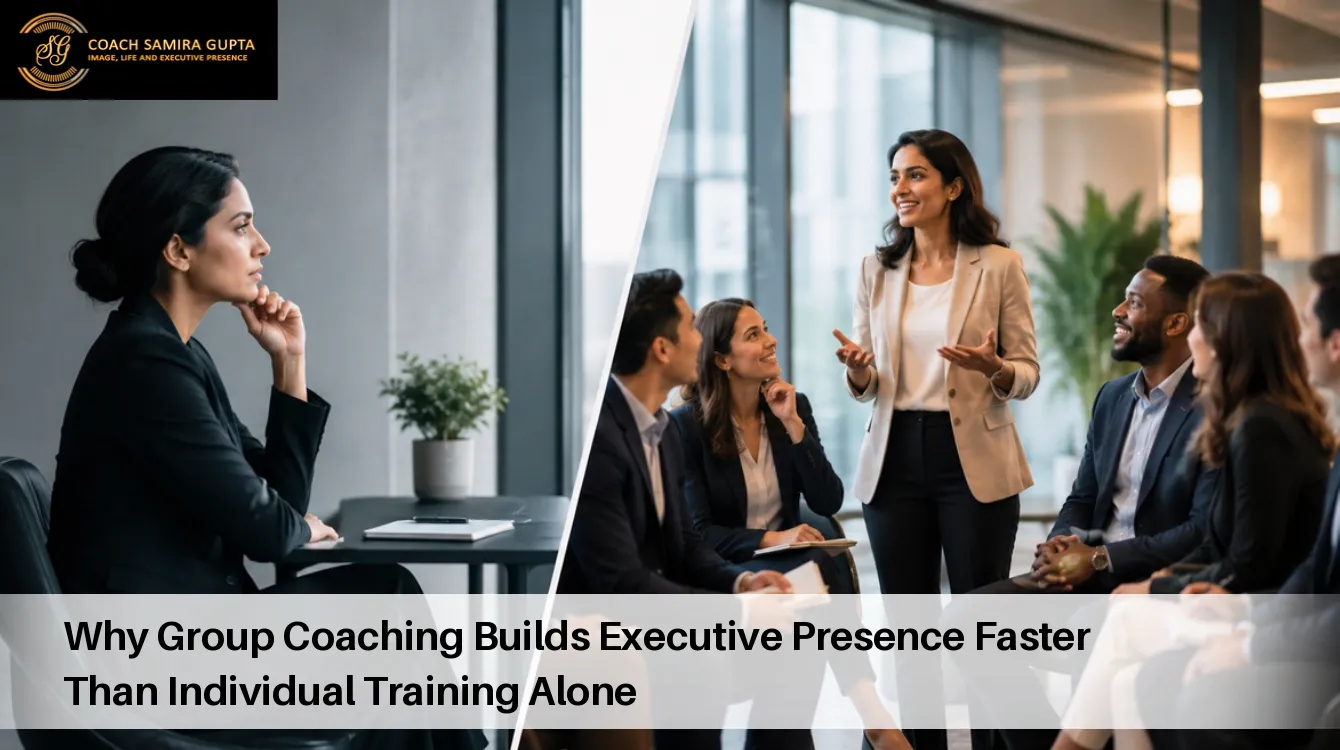
This is where Group Coaching earns its place. A small cohort of senior peers is not simply a nice addition to individual coaching. It is often the more effective environment, because presence can be observed, named, and practiced in real time by the people best positioned to judge whether it is actually landing.
What Group Coaching Is
Group Coaching is a structured, facilitated process in which a small cohort of leaders, typically six to ten, work together over a sustained period using the group itself as the primary learning environment. The group is not a passive audience. It is the active medium of the coaching, providing the feedback and the social conditions that an individual session cannot replicate.
The Three Advantages Specific to Presence Work
1. Peer Feedback Is Immediately Credible
Senior leaders receive remarkably little honest feedback on how they actually come across. In Group Coaching, the feedback comes from peers who are watching the same composure, the same claiming of authority, the same demonstrated capability that boards and stakeholders watch for, and whose perspective carries weight precisely because they are not subordinates, coaches, or stakeholders with an agenda.
2. Practicing Authority in Front of People Who Matter
Claiming authority without apology is genuinely difficult to practice alone. In a Group Coaching session, a leader can rehearse stating a position without hedging, in front of eight respected peers whose reactions provide exactly the kind of real social stakes that the boardroom will eventually demand.
3. The Discovery That Presence Gaps Are Shared
Most senior leaders privately believe their specific struggles, whether that is composure under challenge or discomfort claiming credit, are uniquely theirs. Group Coaching dissolves this belief quickly. Discovering that the leader you most respect in the room is working on the exact same gap you considered a private weakness is one of the most reliably transformative moments I facilitate.
For senior leaders who have never experienced Group Coaching, the consistent report after the first session is the same: I thought I was the only one struggling with this. On presence specifically, they never are.
Who Should Invest in Group Coaching
- A leadership team needs a shared standard for how presence and authority show up, not just individual development in isolation
- Multiple leaders are stepping into more senior, more visible roles at the same time
- Leaders would benefit from honest peer feedback on presence that the hierarchy of their own organisation makes impossible
Frequently Asked Questions
Q: How is Group Coaching different from a leadership training workshop?
A: A workshop delivers content to participants. Group Coaching on Executive Presence uses the group itself as the testing ground, where leaders practice authority and composure live and receive immediate, credible peer reaction, which is the closest possible simulation of how presence is actually judged in real professional settings.
Q: How large is a Group Coaching cohort?
A: Typically six to ten participants. Large enough for diverse perspective and reaction, small enough to preserve the psychological safety that honest feedback on something as personal as presence requires.
Q: Should leaders doing One-to-One Coaching also consider Group Coaching?
A: Yes, they are complementary. One-to-One Coaching builds the underlying capability. Group Coaching tests and sharpens that capability under genuine social conditions, which is where Executive Presence is ultimately judged.
Q: How long does a Group Coaching programme typically run?
A: Most effective programmes run a minimum of three to six months, with sessions fortnightly or monthly, because the trust required for honest presence feedback takes time to build.
Coach Samira Gupta designs and facilitates Group Coaching programmes built around Executive Presence for senior leadership teams across India.
Call: +91 9958934766 | Email: samira@auraaimage.com | Website: www.samiragupta.com